Play Ball!

On a bright Saturday morning this past September, the folks of Hendersonville, North Carolina, turned out to celebrate the listing of the Berkeley Mills Ballpark on the National Register of Historic Places. It was a fun way to celebrate, with a car show, great food (I overdid it on the hotdogs), and a pick-up game.

Hendersonville, located near Asheville, has a vibrant downtown packed with shoppers, diners, and sightseers. Berkeley Mills developed outside town to manufacture cotton products, and after World War II, with newly returned veterans swelling the workforce, the management asked its employees what recreational activities they would like the mill to support. The answer was a ball team.

The Berkeley Spinners team had a successful first season in 1948, playing against other mill teams in the Western North Carolina Industrial League. The following year a ballpark was graded next to a wooded hillside, which became a picnic grounds, and mill employees assisted with construction of a curving wood and steel grandstand, built in 1949 and roofed in 1950. The original dugouts were dug by a local black ball team in exchange for the opportunity to use the field.

The Berkeley ballpark was the only one in its league with lights, which made it popular for league tournaments, though players from other teams complained that homefield lighting gave the Spinners an unfair advantage. Artificial lighting had only recently come into its own in baseball, and the ability to play ball during after-work evening hours powered attendance in the post-war era and helped baseball reach its zenith of popularity.

The Spinners disbanded after the 1961 season. A shrinking mill workforce was the immediate cause, but baseball also waned as television monopolized America’s leisure hours. In later years teams like the Hendersonville Stingrays, the Hendersonville All-Stars, and Brock’s Bombers used the park, as did teams from various youth leagues, including a Babe Ruth Baseball team that finished fifth place in a 2002 world series.

Partway through the September celebration Patrick Gallagher, author of The Berkeley Spinners: A Baseball History, 1948-1961, introduced Dewey Hunnicutt, the last surviving member of the Spinners’ inaugural 1948 team. It was a moving tribute, a link to a vanished era that, in a way, lives on with the fun and excitement of the games played at the revitalized Berkeley Mills Ballpark.
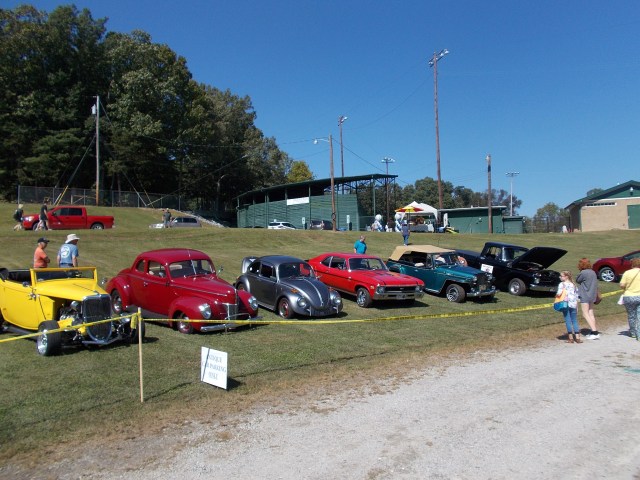
DSCN9106.JPG

Berkeley Mills Ballpark, September 16, 2017

A Way of the Cross from Central Casting

Saint Helena, the pious mother of the Emperor Constantine, was arguably the Holy Land’s first big-name religious tourist. She visited Jerusalem in the fourth century and is said to have returned home with pieces of the True Cross and other souvenirs. But for the average Christian pilgrim a trip to the Holy Land was practically impossible, especially after the region fell under Muslim control. In 1480 the Italian monk Bernardino Caimi came up with a solution: if pilgrims couldn’t visit the Holy Land, why not bring the Holy Land to the pilgrims? The result was the Sacro Monte (Sacred Mountain) of Varallo, a collection of chapels containing life-size dioramas illustrating episodes from the life of Christ.

Varallo must have been wildly successful as a pilgrim magnet because it inspired other sacred mountains all over northern Italy. In the mid-1700s the humble village of Cerveno, located in the Alpine valley of Valcamonica (where the Pezzoni family is from), decided to get in on the act. A sloping gallery lined with alcoves was built onto the parish church and the sculptor Beniamino Simoni (1712-87) was hired to fill the alcoves with vividly painted wooden statuary depicting Christ’s last days, the Via Crucis or Way of the Cross.

The thing that is most remarkable about Simoni’s sculptures is their everyday-ness. Christ is conventionally portrayed and Pilate is garbed like an Ottoman potentate, but the extras who throng the scenes, dressed in their workaday leather breeches, vests, and caps, look like central casting herded them in from the village streets of three hundred years ago. There’s a tradition that Simoni caricatured the local men as a way to shame them into going to church, and most of them are swinish or malicious or dull-witted according to their roles in the drama. Simoni was much kinder with the women, who sorrow fetchingly. Just as impressive is the trompe l’oeil painting of the alcove backdrops and the gallery walls and ceiling, complete with baroque encrustations and even a false window with bull’s-eye glass panes.

I was fortunate to see Simoni’s sculptures in August 2017 and only regret that the tour I was on had to hustle us through. Definitely check out Simoni on the internet. There’s also a short video about the recent restoration of the sculptures, Il Nuovo Sguardo (New Look). It’s in Italian but the imagery gets the point across.

DSCN8936.JPG

Christ appears before Pilate in the Cerveno Way of the Cross

A Renaissance Irony

Filippo Brunelleschi’s Foundling Hospital in Florence is one of my favorite Renaissance buildings. If I had to sum the building up in one word it would be deft. Brunelleschi achieved the perfect marriage of elegance and simplicity: an airy range of round arches on smooth columns forming a front loggia or portico, capped by a hat-band entablature and a plain second story with a neat row of small pedimented windows. Della Robbia’s famous blue-glazed roundels of swaddled infants, tucked into the spandrels between the arches and the entablature, allude to the building’s charitable function (more an orphanage than a hospital in the modern sense) and add a flash of color to the stone and stucco facade.

The Foundling Hospital takes pride of place in the architectural canon as the world’s first Renaissance building. It rejected the pointed Gothic style, which was never more than half-heartedly embraced in Florence, and revived the classicism that would become the defining characteristic of Renaissance architecture. Brunelleschi most likely designed the building in 1419, about the time he began work on the project which would make him famous: the dome of Florence’s cathedral, the first large dome to be attempted since antiquity. But the cathedral dome, though it was inspired by ancient Roman building practice, was not classical in a stylistic sense (other than its later lantern), unlike the Foundling Hospital with its Corinthian-inspired column capitals, round arches, and window pediments.

That is where the irony of the hospital comes in. The classicism it revived was not, for the most part, truly classical. Many of the hospital’s details derived from buildings like the Baptistery in Florence which Brunelleschi and his contemporaries thought was a classical Roman building but was actually a much later Romanesque building. In this sense the Foundling Hospital might be considered an early example of Romanesque Revival, beating H. H. Richardson to the punch by almost 500 years. Or the Romanesque never really died in Florence and early Renaissance classicism was its continuation.

There’s another interesting twist. A decade or two before Brunelleschi designed the hospital, other hospitals were built in Florence or its environs and two surviving examples have front porticos with round arches. Like Brunelleschi’s building these examples have second stories, and that suggests an alternative explanation for the use of round arches: perhaps they were not so much stylistic as a practical response to the need to reduce the height of the portico; pointed Gothic arches on the same columns would have added height and expense. In other words, the practical-minded Brunelleschi adopted a practical solution devised by others before him, though his treatment of the arches and the columns supporting them was more classical than the earlier examples. Brunelleschi did not so much revive the classical/Romanesque round-arched arcade as recognize the feature’s potential to make a stylistic statement.

We could say more if we had Brunelleschi’s own account as to why he revived classicism for his Foundling Hospital. Did he intend to do for the building arts what was already underway in literature and political theory? Did he feel, like the Florentine artist/architect Vasari who came after him, that the Gothic style had “sickened the world” and the cure was classicism? We cannot know for certain, although we can be sure Brunelleschi and his contemporaries did not subscribe to some idle notion of “classicism for classicism’s sake.” Classicism mattered intensely to them, part of the broader transformation of culture and society that set the stage for the modern world.

Longobard Chic

A week into our Italy vacation this summer the kids had burned out on architecture and hill towns so one morning Leslie and I left them to their own (electronic) devices and set out to find a curious early Umbrian building I’d read about. Our map turned out to be wrong and it took us a while to get there, but the Umbrian countryside is not a bad place to get lost in.

The Tempietto del Clitunno, our destination, is an elegant little building perched above a spring-fed pool. The Roman writer Pliny the Younger described the spring waters as “so transparently clear that you may count the shining pebbles.” A millennium and a half later Palladio visited on an architectural fact-finding tour. He measured the Tempietto and drew it up, convinced it was a Roman temple.

Palladio got it wrong but it’s easy to see why. Though it was built as a Christian chapel, the Tempietto looks like a classical temple, complete with podium, modillion cornice, and Corinthian columns with imbricated and swirl-fluted shafts. The Tempietto is essentially one of the last classical buildings, a lineal descendant of the Parthenon and countless other Greek and Roman temples.

Yet the evidence suggests the Tempietto may have been built as late as ca. 700 A.D., long after the end of the Roman Empire, probably for one of the Longobard bigwigs who ruled much of Italy at the time. It’s a testament to the staying power of classical culture, which resident barbarians like the Longobards (“Long Beards”) were keen to emulate for the prestige it bestowed. The quick and easy way to get prestige was to steal it—the columns are spolia (recycled elements) from some unknown Roman building or ruins.

One of the things that made the building so fun for Leslie and me was we could get right up close to the detail. Just like when we study historic buildings in the US, except this one was over a thousand years older. The apse is painted with frescos of Saints Peter and Paul dressed in toga-like white robes and there are carvings of grape clusters, flowers, and foliated crosses in the front and back pediments, the work of stonecarvers skilled in the classical tradition. So much for the culturally benighted Dark Ages, at least in this corner of Italy.

The artisans and their patron are unknown and will probably never be known. The Tempietto is so tangible, so present, and yet so enigmatic. Speaking as someone who devotes himself to solving building mysteries, that is both humbling and exhilarating. The world needs more mystery.

DSCN8667.JPG

Tempietto del Clitunno, Umbria, Italy


The Town that Time Forgot

The Mountain Valley Preservation Alliance recently (June 2017) hosted some excellent tours of the unspoiled town of Fincastle, county seat of Botetourt County near Roanoke, Virginia. The tours began, appropriately enough, at the courthouse, which is one of those intricate architectural history puzzles. Thomas Jefferson provided a design for the county’s courthouse in the 1810s, and an ambitious domed courthouse was constructed, but how much the building owed to Jefferson’s design is unclear. The current building is mostly a reconstruction resulting from a 1970 fire but the Doric portico and circuit court wing survive from the antebellum period.

The time-forgot part of Fincastle is experienced on the back streets, dotted with small clapboarded log houses. The houses don’t date all the way back to the town’s founding in 1772 but they’re evocative of the early days. Fincastle displays a trait seen in other western Virginia towns but obscured by later development: the elevated and peripheral placement of its older churches. Sacred hilltop siting probably dates back to pre-Christian times in western culture with a boost from the Bible (City on a Hill etc.), and peripheral siting reserved room at the heart of town for commercial development and got congregations out of the stink and clamor of downtown.

The churches are Greek Revival gems, with temple fronts, Doric columns in antis (Fincastle Presbyterian), and Asher Benjamin-inspired window treatments (Fincastle UMC). St. Mark’s Episcopal has a Greek pediment above lancet-arched Gothic Revival windows (antebellum western Virginia builders were no purists). Something that caught my eye on the tours was the fancy cast iron crestings over the windows of the Victorian house now operated as 25 E. Main B&B. The crestings reminded me of similar ones on the window lintels of Rockwood, a spectacular Pulaski County house designed and built by Lynchburgers R. C. Burkholder and John P. Pettyjohn in 1874-75. Meanwhile, across from the Botetourt County Courthouse, architect Barry Rakes is diligently rehabilitating a mysterious log house, adding another gem to Fincastle’s architectural crown jewels.

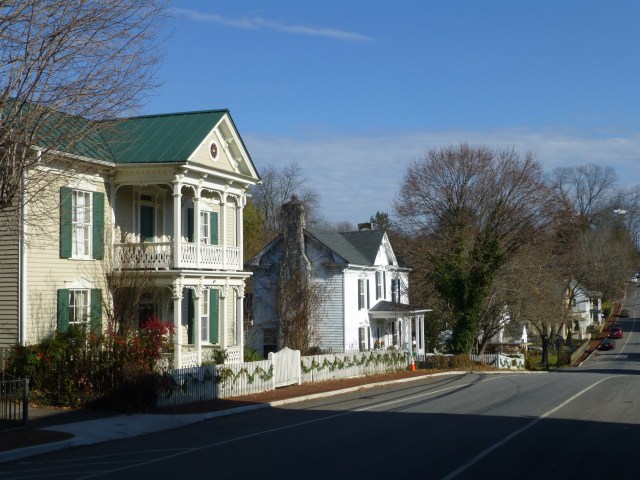
176 Houses in Fincastle.JPGMain Street in Fincastle, Virginia 

The Superstar of Bricks

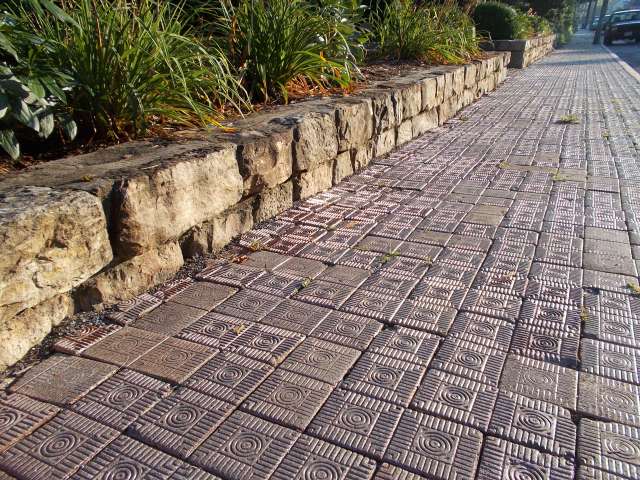
Lexingtonians love their star bricks. A sidewalk paved with the star-emblazoned stamped bricks is a sight to behold, the vitrified finishes glistening in a mineral rainbow of reds and purples and browns. Star bricks are such a feature of Lexington’s downtown and older residential neighborhoods that it’s no surprise people think they’re unique to Lexington, but they’re not. You’ll find them in Roanoke, Savannah, and elsewhere, too.

 Brick paving has a long pedigree in America. Plain brick pavers were popular for walkways in the colonial period, and in the early nineteenth century Washington and Lee University added brick stairs to one of its buildings so the thundering herd of students wouldn’t thunder as loudly as they would on wooden stairs. In 1870 a Charleston, West Virginia builder named Mordecai Levi had the idea to pave a Charleston street in brick. Levi’s timing was good—with mass production and rail transport bricks were cheap enough that cities could afford to pave entire downtowns with them, and they did.

 At the end of the nineteenth century brick plants in Ohio’s Hocking Valley began to manufacture vitrified bricks in a variety of patterns. The glassy vitrification gave the bricks a hard water-impervious finish and the patterns, in addition to providing visual interest, may have helped with traction. The beautiful patterned bricks of the era have withstood the test of time, and today their stars, bull’s-eyes, and hatchings enliven the experience of historic communities across the nation.

DSCN8024.JPG

Bull’s-eye bricks pave a sidewalk on Lee Avenue in Lexington, Virginia


Featured Content

Historic Mills of West Virginia


In 2016 the Raleigh County Historical Society hired me to do a study of water-powered industry in the New River Gorge region of West Virginia. I was thrilled to be tapped for the project, since my family has spent many an October weekend camping in the region, one of the ruggedest terrains in the Appalachians, and I was eager to learn more about local history and West Virginia’s historic buildings.

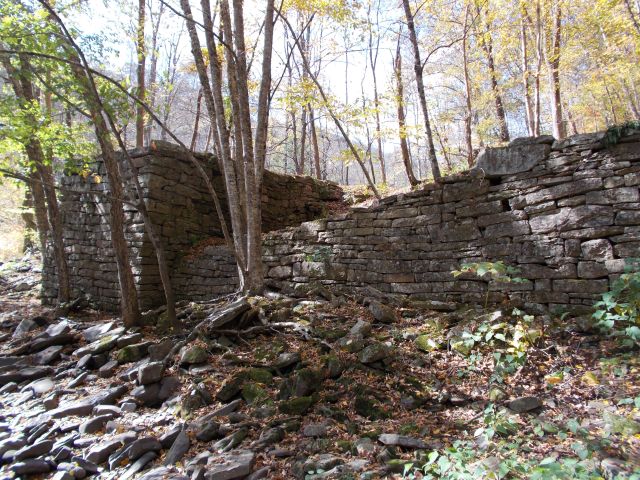
I’ve done several National Register nominations for mills in the valley/piedmont region of Virginia and had a certain idea what to expect in the Gorge region—basically multi-story merchant mills, geared to producing flour and corn meal for shipment to distant markets. Merchant mills did exist in the region, and one of them was a special focus of the study: the Beckley Mill, built by the entrepreneurial Alfred Beckley in the Pine Creek gorge below the city of Beckley (named not for Alfred but for his father John Beckley, the first Librarian of Congress). Today the Beckley Mill survives as a set of imposing stone foundations, a sort of West Virginia Machu Picchu, but during its nineteenth-century heyday the timber-framed mill, which had an overshot wheel and an associated sawmill, was one of the area’s chief industries.

The surprise of the study was that mills like Beckley’s were rare. Far more common were tub mills, so named for the tubs in which their crude paddle-wheel-like wheels sat. Tub mills were simple affairs that could run on water conducted through hollowed-out logs. No need for expensive gearing, millraces, and flumes. In retrospect, the preponderance of tub mills makes sense. The region was so rugged, with so little arable land, that the small crops of corn and wheat couldn’t sustain many merchant mills. Scattered tub mills were better suited to the region’s patchwork agriculture.

At the other end of the spectrum were commercial sawmills which appeared at the western end of the Gorge by the end of the antebellum period. These clustered below Kanawha Falls, the head of navigation on the Kanawha/Ohio/Mississippi drainage. The location was ideal for large-scale sawmilling with stands of virgin timber and convenient river transport at its doorstep and “the finest water power to propel machinery of any perhaps in Virginia,” according to an 1835 gazetteer. The sawmills were also the first water-powered mills in the region to appear in images. The “Flat-Boat Yard of Messrs. Lewis & Miller” at Kanawha Falls was portrayed by German artist Edward Beyer in his Album of Virginia (1858). The lithograph shows an open-sided gable-roofed shed with skids leading down the riverbank—apparently the sawmill that supplied lumber for the boatyard.

Kanawha Falls marked the upstream end of a chain of saltworks that extended downriver to Charleston. The densely settled and technologically advanced saltworks zone existed side by side with the lightly developed Gorge region. The region’s relatively unspoiled character changed almost overnight with completion of the Chesapeake and Ohio Railroad through the Gorge in 1873. Huge steam-powered lumber mills moved in and converted whole forests to cutover moonscapes, but traditional water-powered gristmills continued to operate in the shadow of the mega mills. An interesting historiographic twist is the mismatch between statistical accounts of West Virginia grist-milling, which indicate dwindling numbers of mills during the early twentieth century, and oral history accounts which suggest many small mills continued to operate back in the hollows, at least through the 1930s.

But even the diehards eventually shut down and today only three water-powered mills are known to survive in the region: Cooper’s Mill on the Little Bluestone River in Summers County, Ball’s Mill on Laurel Creek in Fayette County, and the Glade Creek Mill at Babcock State Park in Fayette County. The Glade Creek Mill actually began life as the ca. 1890 Stoney Creek Gristmill from Pocahontas County, which was dismantled, moved to Babcock, and reconstructed in 1976. The promoters of the move and reconstruction were marketing geniuses; today the picturesquely sited Glade Creek Mill is one of the best-loved and most-photographed historic mills in the nation.DSCN1801.JPG

Beckley Mill foundation (right) and associated bridge abutment (left)

This is a featured content post. Click the Edit link to modify or delete it, or start a new post.