
Historic Mills of West Virginia
In 2016 the Raleigh County Historical Society hired me to do a study of water-powered industry in the New River Gorge region of West Virginia. I was thrilled to be tapped for the project, since my family has spent many an October weekend camping in the region, one of the ruggedest terrains in the Appalachians, and I was eager to learn more about local history and West Virginia’s historic buildings.
I’ve done several National Register nominations for mills in the valley/piedmont region of Virginia and had a certain idea what to expect in the Gorge region—basically multi-story merchant mills, geared to producing flour and corn meal for shipment to distant markets. Merchant mills did exist in the region, and one of them was a special focus of the study: the Beckley Mill, built by the entrepreneurial Alfred Beckley in the Pine Creek gorge below the city of Beckley (named not for Alfred but for his father John Beckley, the first Librarian of Congress). Today the Beckley Mill survives as a set of imposing stone foundations, a sort of West Virginia Machu Picchu, but during its nineteenth-century heyday the timber-framed mill, which had an overshot wheel and an associated sawmill, was one of the area’s chief industries.
The surprise of the study was that mills like Beckley’s were rare. Far more common were tub mills, so named for the tubs in which their crude paddle-wheel-like wheels sat. Tub mills were simple affairs that could run on water conducted through hollowed-out logs. No need for expensive gearing, millraces, and flumes. In retrospect, the preponderance of tub mills makes sense. The region was so rugged, with so little arable land, that the small crops of corn and wheat couldn’t sustain many merchant mills. Scattered tub mills were better suited to the region’s patchwork agriculture.
At the other end of the spectrum were commercial sawmills which appeared at the western end of the Gorge by the end of the antebellum period. These clustered below Kanawha Falls, the head of navigation on the Kanawha/Ohio/Mississippi drainage. The location was ideal for large-scale sawmilling with stands of virgin timber and convenient river transport at its doorstep and “the finest water power to propel machinery of any perhaps in Virginia,” according to an 1835 gazetteer. The sawmills were also the first water-powered mills in the region to appear in images. The “Flat-Boat Yard of Messrs. Lewis & Miller” at Kanawha Falls was portrayed by German artist Edward Beyer in his Album of Virginia (1858). The lithograph shows an open-sided gable-roofed shed with skids leading down the riverbank—apparently the sawmill that supplied lumber for the boatyard.
Kanawha Falls marked the upstream end of a chain of saltworks that extended downriver to Charleston. The densely settled and technologically advanced saltworks zone existed side by side with the lightly developed Gorge region. The region’s relatively unspoiled character changed almost overnight with completion of the Chesapeake and Ohio Railroad through the Gorge in 1873. Huge steam-powered lumber mills moved in and converted whole forests to cutover moonscapes, but traditional water-powered gristmills continued to operate in the shadow of the mega mills. An interesting historiographic twist is the mismatch between statistical accounts of West Virginia grist-milling, which indicate dwindling numbers of mills during the early twentieth century, and oral history accounts which suggest many small mills continued to operate back in the hollows, at least through the 1930s.
But even the diehards eventually shut down and today only three water-powered mills are known to survive in the region: Cooper’s Mill on the Little Bluestone River in Summers County, Ball’s Mill on Laurel Creek in Fayette County, and the Glade Creek Mill at Babcock State Park in Fayette County. The Glade Creek Mill actually began life as the ca. 1890 Stoney Creek Gristmill from Pocahontas County, which was dismantled, moved to Babcock, and reconstructed in 1976. The promoters of the move and reconstruction were marketing geniuses; today the picturesquely sited Glade Creek Mill is one of the best-loved and most-photographed historic mills in the nation.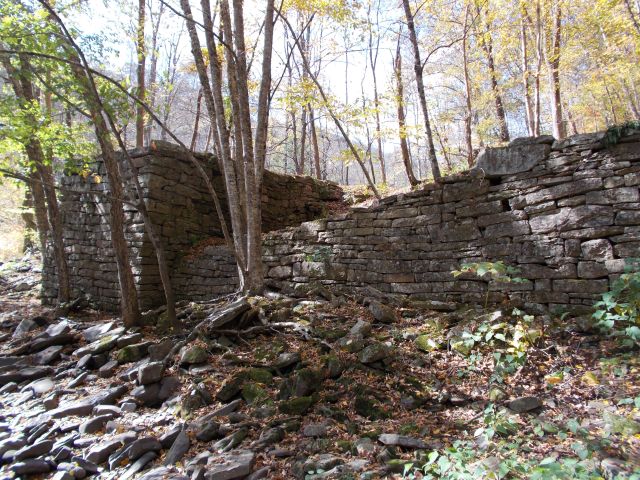
Beckley Mill foundation (right) and associated bridge abutment (left)
This is a featured content post. Click the Edit link to modify or delete it, or start a new post.

